



Tracy Flight Panel Extensions
This is a set of extensions to make working with Flight a little richer.
- Flight - Analyze all Flight variables.
- Database - Analyze all queries that have run on the page (if you correctly initiate the database connection)
- Request - Analyze all
$_SERVERvariables and examine all global payloads ($_GET,$_POST,$_FILES) - Session - Analyze all
$_SESSIONvariables if sessions are active. - Twig (optional) - Analyze Twig template render time, memory, and which templates/blocks/macros ran (requires
twig/twigand atwig_profileconfig)
This is especially handy with the official skeleton, which defaults to Twig: the same layout AI tools follow also shows up clearly on the Tracy bar.
This is the Panel

And each panel displays very helpful information about your application!
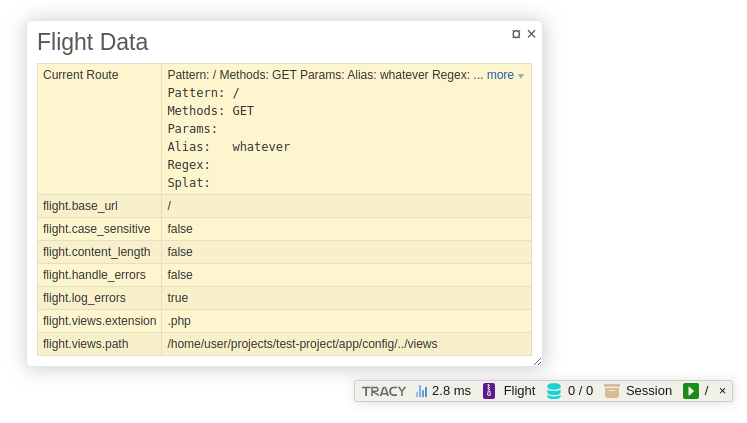
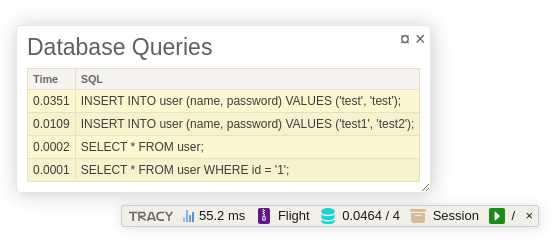
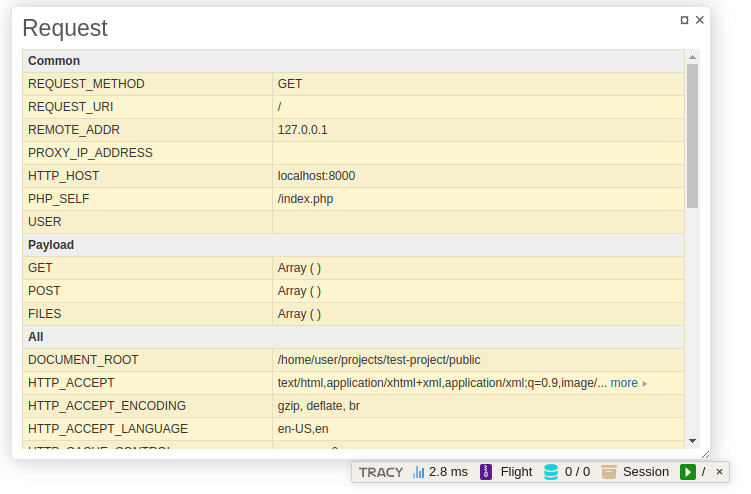
Click here to view the code.
Installation
Run composer require flightphp/tracy-extensions --dev and you're on your way!
Twig is not a hard dependency of the package. Install twig/twig only if you want the Twig panel (the skeleton already does for views).
Configuration
There is very little configuration you need to do to get this started. You will need to initiate the Tracy debugger prior to using this https://tracy.nette.org/en/guide:
<?php

use Tracy\Debugger;
use flight\debug\tracy\TracyExtensionLoader;

// bootstrap code
require __DIR__ . '/vendor/autoload.php';

Debugger::enable();
// You may need to specify your environment with Debugger::enable(Debugger::DEVELOPMENT)

// if you use database connections in your app, there is a
// required PDO wrapper to use ONLY IN DEVELOPMENT (not production please!)
// It has the same parameters as a regular PDO connection
$pdo = new PdoQueryCapture('sqlite:test.db', 'user', 'pass');
// or if you attach this to the Flight framework
Flight::register('db', PdoQueryCapture::class, ['sqlite:test.db', 'user', 'pass']);
// now whenever you make a query it will capture the time, query, and parameters

// This connects the dots
if(Debugger::$showBar === true) {
    // This needs to be false or Tracy can't actually render :(
    Flight::set('flight.content_length', false);
    new TracyExtensionLoader(Flight::app());
}

// more code

Flight::start();
Additional Configuration
Session Data
If you have a custom session handler (such as ghostff/session), you can pass any array of session data to Tracy and it will automatically output it for you. You pass it in with the session_data key in the second parameter of the TracyExtensionLoader constructor.
use Ghostff\Session\Session;
// or use flight\Session;

require 'vendor/autoload.php';

$app = Flight::app();

$app->register('session', Session::class);

if(Debugger::$showBar === true) {
    // This needs to be false or Tracy can't actually render :(
    Flight::set('flight.content_length', false);
    new TracyExtensionLoader(Flight::app(), [ 'session_data' => Flight::session()->getAll() ]);
}

// routes and other things...

Flight::start();
Twig panel (optional)
If your app uses Twig (including the official skeleton), you can show template metrics on the Tracy bar. Create a Twig Profile, attach ProfilerExtension to your environment, then pass that profile into the loader under the twig_profile key. Attach profiling only in development.
<?php

use flight\debug\tracy\TracyExtensionLoader;
use flight\debug\tracy\TwigTracyExtension;
use Tracy\Debugger;
use Twig\Environment;
use Twig\Extension\ProfilerExtension;
use Twig\Loader\FilesystemLoader;
use Twig\Profiler\Profile;

$loader = new FilesystemLoader(__DIR__ . '/views');
$twig = new Environment($loader, [
    'debug' => true,
    'cache' => false,
]);

// Optional: expose Tracy dump helpers in templates
// {{ dump(var) }}, {{ bdump(var) }}, {{ dumpe(var) }}
$twig->addExtension(new TwigTracyExtension());

$tracyConfig = [];
if (Debugger::$showBar === true) {
    $profile = new Profile();
    $twig->addExtension(new ProfilerExtension($profile));
    $tracyConfig['twig_profile'] = $profile;
}

if (Debugger::$showBar === true) {
    Flight::set('flight.content_length', false);
    new TracyExtensionLoader(Flight::app(), $tracyConfig);
}

// Map Flight::render() to Twig (example)
Flight::map('render', function (string $template, array $data = []) use ($twig) {
    if (substr($template, -5) !== '.twig') {
        $template .= '.twig';
    }
    echo $twig->render($template, $data);
});
What the panel shows
- Total Twig render time and memory
- Template / block / macro call counts
- Each template that rendered, with its own time and memory
The Twig tab is hidden when no templates were rendered for the request, or when you omit twig_profile (or do not have Twig installed)—other Flight panels keep working.
In a skeleton-style services.php, build the same $profile / ProfilerExtension when debug is on, pass twig_profile into TracyExtensionLoader, and keep using your shared Twig environment for $app->render().
Latte
PHP 8.1+ is required for this section.
If you have Latte installed in your project, Tracy has a native integration with Latte to analyze your templates. You simply register the extension with your Latte instance (this is Latte’s own Tracy bridge, not the Twig panel above).
require 'vendor/autoload.php';

$app = Flight::app();

$app->map('render', function($template, $data, $block = null) {
    $latte = new Latte\Engine;

    // other configurations...

    // only add the extension if Tracy Debug Bar is enabled
    if(Debugger::$showBar === true) {
        // this is where you add the Latte Panel to Tracy
        $latte->addExtension(new Latte\Bridges\Tracy\TracyExtension);
    }

    $latte->render($template, $data, $block);
});
See Also
- Tracy - Base Tracy setup for Flight
- Twig - Templating used by the skeleton and the Twig panel
- Templates - How Flight maps
renderto Twig/Latte - Installation - Skeleton includes tracy-extensions in dev